

Why Newark Patients Are Choosing the Most Reliable Tooth Replacement in Modern Dentistry
When you’re missing one or more teeth, the decision of how to replace them will affect your daily life for years, possibly decades to come. You want something that looks natural, feels comfortable, and most importantly, lasts. That’s exactly why dental implants have become the gold standard in modern tooth replacement—and why more and more patients throughout Licking County are choosing them at Newark Dental Associates.
At the heart of the dental implant conversation is a number that surprises almost every patient who hears it: dental implants carry a 95 to 98% success rate over 10 years. That’s not a marketing claim—it’s a figure supported by decades of clinical research and peer-reviewed studies. In a world where very few medical or dental procedures come with that level of reliability, that statistic says something remarkable about the technology, the biology, and the expertise behind it.
So what’s behind that number? Why do implants succeed at such a high rate, and what do Dr. Brian Stickel and the team at Newark Dental Associates do to make sure you’re in that successful majority? Let’s break it all down.

What Does “Success Rate” Actually Mean for Dental Implants?
Before diving into the why, it’s worth clarifying what a 95–98% success rate actually means in clinical terms. An implant is considered “successful” when it meets several criteria after a defined period—typically 10 years—including the following:
- The implant remains firmly integrated with the jawbone (osseointegration is maintained)
- There’s no persistent pain, infection, or nerve damage at the implant site
- The implant has not fractured or required removal
- The surrounding bone hasn’t deteriorated beyond acceptable thresholds
- The patient can use the implant normally for chewing and everyday functions
This is a rigorous standard, not just “the tooth is still there.” And the fact that implants meet all of these criteria at a 95 to 98% rate across thousands of patients and multiple studies is what sets them apart from every other tooth replacement option available today.
For context, traditional dentures require replacement every 5 to 8 years and offer no support for the underlying jawbone. Dental bridges, while fixed, typically last 10 to 15 years and require altering the healthy teeth on either side. Implants, by contrast, are designed to be permanent, and the clinical evidence backs that up.
The Science Behind the Success: Osseointegration
The reason dental implants work as well as they do comes down to one remarkable biological process: osseointegration. This is the fusion of a titanium implant post with the living bone tissue of your jaw—and it’s what makes implants fundamentally different from any other tooth replacement option.
When Dr. Stickel places an implant at our Newark office, he’s inserting a small, biocompatible titanium post into your jawbone. Over the following 3 to 6 months, your bone tissue gradually grows around and bonds to the surface of that titanium post. The result is an anchor that becomes, quite literally, part of your jaw—more stable than a natural tooth root in many cases.
Titanium is used in over 93% of dental implants in the United States specifically because of its biocompatibility—the human body doesn’t reject it, and bone bonds to it naturally. This isn’t a discovery: titanium osseointegration was first observed by Swedish orthopedic surgeon Per-Ingvar Brånemark in the 1950s and has been refined over 70+ years of clinical use.
| Why This Matters for Newark Patients: Once osseointegration is complete, the implant is no longer a foreign object—it’s a functional part of your jaw. This is why implants can last a lifetime while other tooth replacements cannot. |
Key Factors That Drive Implant Success — And How Newark Dental Addresses Each One
While the overall success rate is impressively high, it’s not automatic. The outcomes behind that 95 to 98% figure are the result of careful patient selection, precise surgical technique, and the quality of aftercare. Here’s what actually drives implant success—and how Dr. Stickel’s approach at Newark Dental Associates addresses each factor.
1. Precise Treatment Planning with 3D Imaging
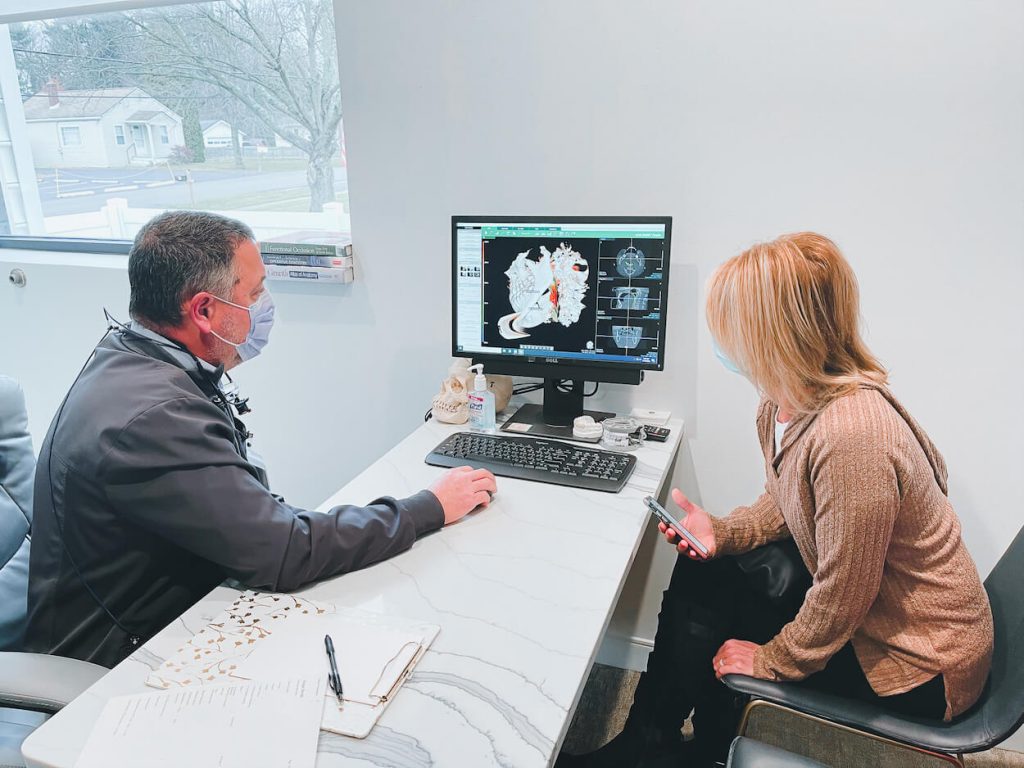
One of the biggest predictors of implant success is accurate placement. An implant placed even a few millimeters off-target can result in nerve contact, insufficient bone support, or bite misalignment—all of which can contribute to failure. This is why Dr. Stickel uses in-office 3D cone beam computed tomography (CBCT) imaging before every implant case.
3D CBCT imaging gives Dr. Stickel a full three-dimensional view of your jawbone density, nerve locations, sinus anatomy, and available bone volume. Research published in peer-reviewed literature shows that 3D-guided implant planning significantly reduces the risk of complications compared to traditional 2D X-rays. At Newark Dental Associates, this technology is available right in our office — no outside referral needed.
2. Specialized Implant Training and Certification
General dental training doesn’t cover implant surgery in depth—it’s a specialized discipline that requires advanced education. Dr. Stickel, your Newark dentist at Newark Dental Associates, has completed advanced implant training at two of the most respected programs in the country:
- Misch Resnik Implant Institute
- Midwest Implant Institute
- Member, International Congress of Oral Implantologists (ICOI)
- Certified Hybridge Full-Arch Implant Provider—one of a select group in Central Ohio
This level of specialized education directly translates to better outcomes. Surgeons with advanced implant training have lower complication rates, more accurate placement, and a deeper ability to manage complex cases—including patients who have been told elsewhere that they aren’t candidates for implants.
3. Thorough Candidacy Evaluation
Not every patient is an ideal implant candidate from the start, and one of the most important things a skilled implant dentist does is identify and address the factors that could compromise success before surgery begins. The most common risk factors include:
- Bone Density: Insufficient bone can’t support osseointegration. Dr. Stickel evaluates bone quality with 3D imaging and offers bone grafting when needed.
- Gum Disease: Active periodontal disease dramatically increases the risk of peri-implantitis—an infection around the implant. Gum disease must be treated first.
- Smoking: Tobacco use impairs healing and increases the risk of implant failure by up to 2.5x. Dr. Stickel has an honest conversation with every patient who smokes before proceeding.
- Systemic Conditions: Uncontrolled diabetes, certain blood conditions, and medications affecting bone metabolism are all evaluated carefully in your consultation.
By identifying and addressing these factors upfront—rather than discovering them mid-treatment—Newark Dental Associates gives every patient the best possible chance of a successful outcome.
4. IV Sedation for a Comfortable, Controlled Experience
Dental anxiety affects roughly 36% of Americans, and when patients are stressed or in pain during surgery, it can affect healing and outcomes. Dr. Stickel is IV-sedation certified—a credential most general dentists in the Newark and Licking County areas do not hold. Patients who receive IV sedation are fully relaxed throughout the procedure, which reduces physical stress on the surgical site and allows for more precise, unhurried work.
If dental fear has been holding you back from exploring implants, IV sedation at our 1478 W. Main St. office changes that conversation entirely.
5. Ongoing Maintenance and Follow-Up
An implant placed with precision is not automatically a lifetime implant—proper implant maintenance matters. The leading cause of late implant failure is peri-implantitis, a bacterial infection of the tissue surrounding the implant that’s closely related to gum disease. The good news: it’s highly preventable with the same habits that protect your natural teeth.
At Newark Dental Associates, every implant patient receives a clear maintenance protocol and regular monitoring checkups to catch any early warning signs before they become serious. Our team will work with you on personalized oral hygiene strategies, including water flossers, which are particularly effective around implant sites.

How Does That Success Rate Compare to Other Tooth Replacement Options?
To appreciate what a 95–98% success rate really means, it helps to compare implants to the alternatives most Newark patients consider:
| Feature | Dental Implants | Dental Bridges | Traditional Dentures |
| 10-Year Success Rate | 95–98% | ~90% | N/A (replaced every 5–8 yrs) |
| Preserves Jawbone | Yes | No | No |
| Feels Like Natural Teeth | Yes | Mostly | No |
| Lifespan | Lifetime (implant body) | 10 to 15 years | 5 to 8 years |
| Requires Altering Other Teeth | No | Yes | No |
| Daily Removal Required | No | No | Yes |
| Long-Term Cost Value | Best | Moderate | Highest (replacements + adhesives) |
The data doesn’t lie: no other tooth replacement option offers the combination of longevity, bone preservation, and natural function that dental implants do.
Who Is a Good Candidate for Dental Implants in Newark, OH?
The majority of adults in good general health are excellent implant candidates. The core requirements are sufficient jawbone density and healthy gum tissue — both of which Dr. Stickel evaluates in detail during your initial consultation. Even if you’ve experienced significant bone loss or have been told you aren’t a candidate for dental implants elsewhere, there are often options:
- Bone Grafting: Rebuilds the foundation where bone has resorbed after tooth loss, making implants possible for patients who previously didn’t qualify.
- Hybridge Full-Arch Implants: For patients with significant bone loss needing full arch replacement, Hybridge often requires less grafting than traditional full-arch approaches.
- Mini Dental Implants: A narrower-diameter option suitable for patients with limited bone volume or those needing denture stabilization.
If you’re in Newark, Heath, Granville, Johnstown, Pataskala, or anywhere throughout Licking County and have questions about whether implants are right for you, the only way to know for certain is a personal consultation with Dr. Brian Stickel at Newark Dental Associates.
Real-World Implant Longevity: What 30+ Years of Research Tells Us
The 10-year success benchmark is well established, but what about the long term? Long-term implant studies tell an equally compelling story. Research following implant patients over 20–30 years has consistently found:
- Implant survival rates of 90–95% at 20 years when placed in healthy patients with good bone support
- Implant body (the titanium post) failure is rare once osseointegration is complete—most “replacements” involve only the crown, not the implant itself
- Patients with excellent oral hygiene and no systemic risk factors routinely use the same implants for 25–30 years or more
Put simply: an implant placed today by a skilled, specialized dentist—with proper patient selection, advanced imaging, and good aftercare—is very likely to still be serving you well in 2050.
What About Hybridge? Newark’s Newest Full-Arch Implant Option
For patients dealing with failing teeth, severe decay across multiple teeth, or longstanding struggles with ill-fitting dentures, Newark Dental Associates is now one of a select group of Hybridge-certified providers in Central Ohio — the only one currently serving the Newark and Licking County area.
Hybridge is a full-arch restoration system that replaces an entire upper or lower arch of teeth using 5–6 strategically placed titanium implants supporting a fixed, permanent bridge. Unlike conventional full-arch implant approaches that can stretch over 12–18 months, Hybridge’s proven four-step protocol delivers most patients their final smile in as little as two weeks. Patients leave surgery the same day with temporary teeth already in place.
The Hybridge bridge itself is made from a proprietary cross-linked PMMA and chrome-cobalt material, manufactured in a dedicated U.S.-based specialty lab—and it’s specifically engineered for long-term strength and aesthetic results.
| Is Hybridge Right for You? If you have failing teeth, uncomfortable dentures, or have been told you need significant dental work, Hybridge may offer a faster, more cost-effective path to a permanent smile than you think. Call (740) 344-4000 to discuss your options. |
Ready to Experience the Gold Standard? Schedule Your Implant Consultation in Newark, OH
You don’t have to live with missing teeth, uncomfortable dentures, or a smile you’re not confident in. The same procedure that carries a 95–98% success rate is available right here in Licking County—with the advanced training, 3D imaging technology, and personalized care that gives that statistic real meaning for your specific situation.
Dr. Brian Stickel and the team at Newark Dental Associates welcome patients from Newark, Heath, Granville, Johnstown, Pataskala, and throughout Central Ohio. Whether you need a single tooth replaced or a full-arch restoration, we have the implant solution and the expertise to restore your smile for life.Call us today at (740) 344-4000 to request your consultation. Your first step toward a permanent, confident smile starts with a single conversation—and we’d be glad to have it with you. Our Newark dental office is located at 1478 W. Main St., Newark, OH 43055.